


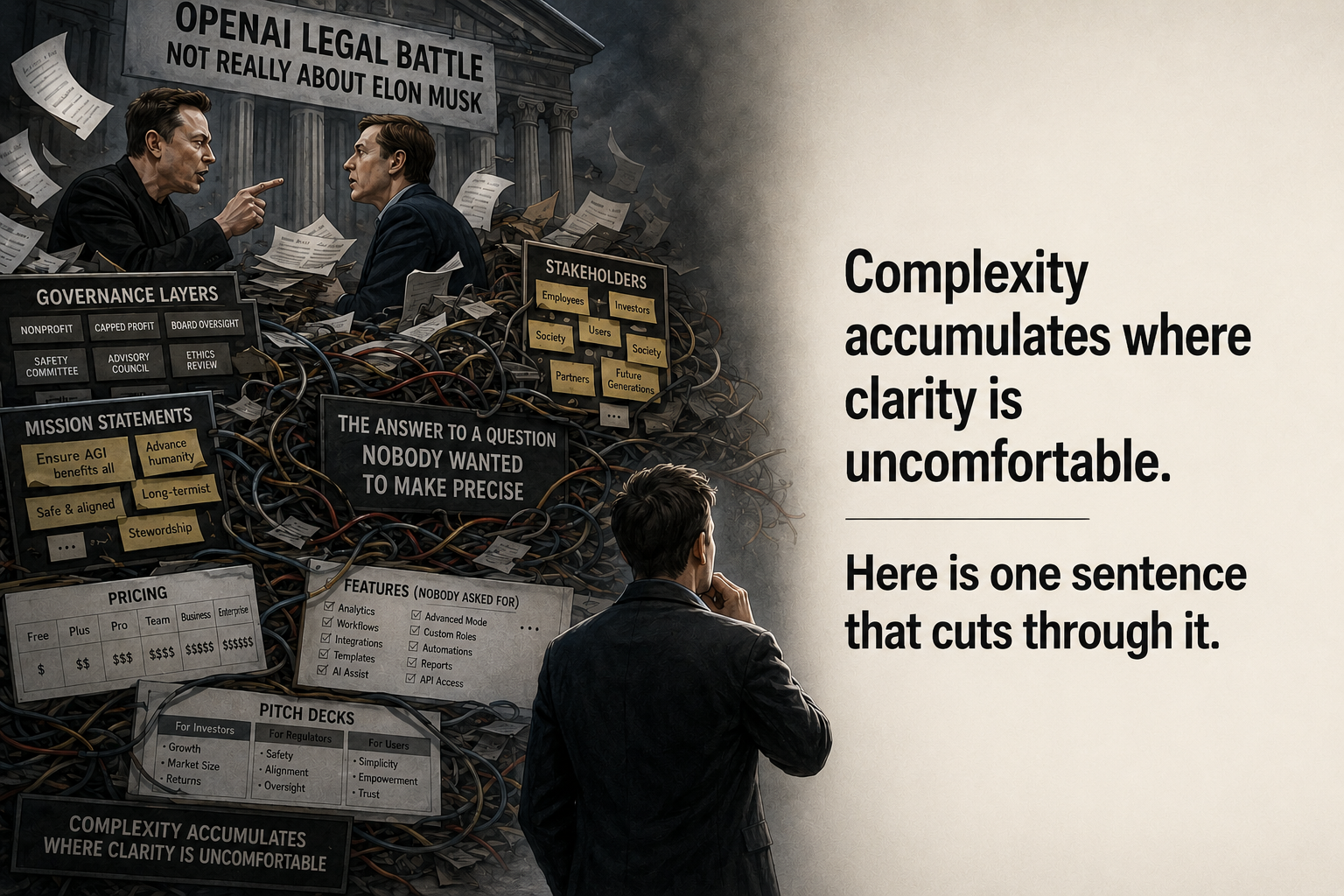
The Musk vs. OpenAI lawsuit dominating the news this week isn't really about money.
At its core, it's about the fact that OpenAI's founding mission was never defined with enough precision to be enforceable. What exactly does "safe AI for the benefit of humanity" mean? Who controls it? What happens when commercial interests and that mission diverge? Nobody wrote the hard sentence. They built governance structures, board layers, and legal entities instead — each one adding complexity where clarity was the thing that was actually needed.
The labyrinth didn't cause the dispute. It was the answer to the discomfort of being specific.
You've seen this at a much smaller scale in your own business.
The pricing page with six tiers. The product with features nobody asked for. The pitch that's subtly different every time you give it, depending on who's in the room. None of this happened because you weren't working hard. It happened because every layer of complexity bought you a little more time before the essential question became unavoidable.
That question is usually some version of: does anyone actually need what I'm building, in the specific form I'm building it?
Complexity is the sophisticated founder's way of not finding out yet.
The SaaS companies currently being squeezed out of existence by AI tools learned this the hard way. For years, six pricing tiers and a 40-feature dashboard looked like a product strategy. Then AI flattened the value proposition overnight and exposed what was always underneath it: founders who'd been adding features to postpone the moment of reckoning. The market eventually forces the question. The ones who asked it themselves first are the ones still standing.
There's a test for this. It's uncomfortable by design.
Write your pitch in one sentence. Not a tagline. A sentence that says what you do, who it's for, and what changes because of it. A sentence that a stranger could repeat back to you accurately five minutes later.
If you can write it easily, you already know what's essential. If you keep rewriting and it still doesn't feel completely true, the complexity is concealing something. Keep going until the sentence hurts a little — because it commits you to something specific, and specificity closes doors.
That's the point. The doors it closes are the ones you were hiding behind.
Before next Monday:
Write the sentence. One draft isn't enough — write five versions, each one simpler than the last. The version that makes you slightly uncomfortable because it removes your escape routes? That's the one.
OpenAI didn't write that sentence in 2015. They're writing it now, in court, with lawyers.
You still have the option to write it yourself.
Monday Morning lands every week. One pattern. One shift. One thing to do before Friday. → Can't write the sentence? Your PMF assessment will tell you exactly what it should contain — free at clarityonpmf.com
At its core, it's about the fact that OpenAI's founding mission was never defined with enough precision to be enforceable. What exactly does "safe AI for the benefit of humanity" mean? Who controls it? What happens when commercial interests and that mission diverge? Nobody wrote the hard sentence. They built governance structures, board layers, and legal entities instead — each one adding complexity where clarity was the thing that was actually needed.
The labyrinth didn't cause the dispute. It was the answer to the discomfort of being specific.
You've seen this at a much smaller scale in your own business.
The pricing page with six tiers. The product with features nobody asked for. The pitch that's subtly different every time you give it, depending on who's in the room. None of this happened because you weren't working hard. It happened because every layer of complexity bought you a little more time before the essential question became unavoidable.
That question is usually some version of: does anyone actually need what I'm building, in the specific form I'm building it?
Complexity is the sophisticated founder's way of not finding out yet.
The SaaS companies currently being squeezed out of existence by AI tools learned this the hard way. For years, six pricing tiers and a 40-feature dashboard looked like a product strategy. Then AI flattened the value proposition overnight and exposed what was always underneath it: founders who'd been adding features to postpone the moment of reckoning. The market eventually forces the question. The ones who asked it themselves first are the ones still standing.
There's a test for this. It's uncomfortable by design.
Write your pitch in one sentence. Not a tagline. A sentence that says what you do, who it's for, and what changes because of it. A sentence that a stranger could repeat back to you accurately five minutes later.
If you can write it easily, you already know what's essential. If you keep rewriting and it still doesn't feel completely true, the complexity is concealing something. Keep going until the sentence hurts a little — because it commits you to something specific, and specificity closes doors.
That's the point. The doors it closes are the ones you were hiding behind.
Before next Monday:
Write the sentence. One draft isn't enough — write five versions, each one simpler than the last. The version that makes you slightly uncomfortable because it removes your escape routes? That's the one.
OpenAI didn't write that sentence in 2015. They're writing it now, in court, with lawyers.
You still have the option to write it yourself.
Monday Morning lands every week. One pattern. One shift. One thing to do before Friday. → Can't write the sentence? Your PMF assessment will tell you exactly what it should contain — free at clarityonpmf.com


