


The Playbook Nobody Talks About
There is a company that doesn't sell you a product by telling you about the product. It sells you a worldview first, and the product becomes the only logical conclusion.
Watch how it works.
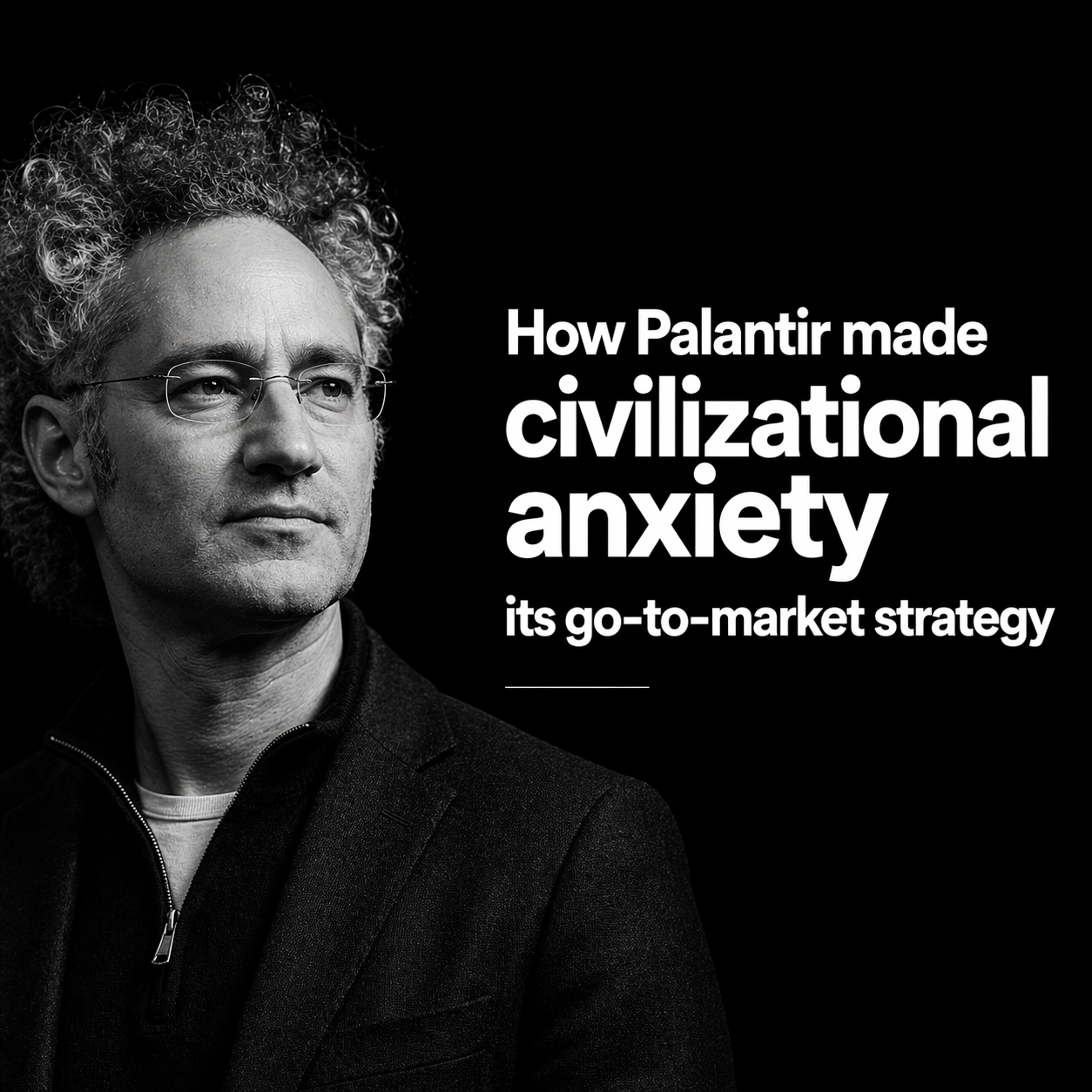
For over a decade, Alex Karp has given the same speech in different rooms. In Davos, at ETH Zurich, at Washington defense forums, in the pages of the New York Times, at his own company events, and now in a book that hit number one on the bestseller list. The speech has a consistent structure: the West is in danger, adversaries are not constrained by your ethical hesitation, and software will determine who wins. The framing is always binary: "We are going to be the dominant player, or China is going to be the dominant player, and there will just be very different rules depending on who wins." Axios
Every time Karp says this, he is not just expressing a geopolitical view. He is shrinking the market to the buyers who agree with him, and expanding it to every government agency, military branch, and intelligence service that feels the same urgency.
Start with the obligation
The foundation of the whole structure is moral debt. The argument goes: Silicon Valley was built by a free society, defended by a military, and enriched by a nation. Therefore, the engineering class owes that nation something. Not charity. Not taxes. Defense contracts.
The genius of this framing is that it doesn't ask potential customers to want surveillance AI. It asks potential customers to feel that demanding it is their right, even their patriotic duty. And it simultaneously positions every competitor who hesitates — Google, Microsoft, any company that faced employee revolt over defense work — as morally deficient. Not just commercially squeamish. Actually failing their country.
This clears the field on two fronts simultaneously. Karp has consistently argued for the need to realign Silicon Valley's focus from consumer applications to national defense and infrastructure. Blogger When a company makes that argument loudly and publicly, it doesn't just describe its own values — it delegitimizes the competitive hesitation of rivals who've backed away from military contracts due to internal pressure. And it functions as recruitment policy communicated in public: engineers who object to military AI self-select out, which means Palantir avoids the internal revolts that grounded Google's Project Maven and Microsoft's HoloLens military programmes. The manifesto isn't just messaging to governments. It is a talent filter with a trillion-dollar consequence.
The inevitability argument
The second move is more sophisticated. Once the obligation is established, you introduce inevitability. The question is never whether AI weapons will be built — only who builds them and toward what ends. This is the oldest sales technique in the defense industry, updated for the AI era.
Karp's position is that we're hurtling toward this new world whether we like it or not. The question is: do we want to dominate it, or be dominated? Pelayo Arbues Notice what this framing does. It eliminates opt-out as a rational choice. If the weapons are coming regardless, then objecting to their development isn't principled — it's simply handing the future to your adversaries.
For every government official, military procurement officer, or intelligence agency head who sits across from Palantir in a meeting, this argument does heavy lifting before the product demo even begins. The sale is already half-made by the ideology.
The same rhetorical structure — inevitability plus urgency — runs through every domain Palantir operates in. It is not a one-off argument about military AI. It is the operating logic of the entire expansion.
Manufacture the fear, sell the solution
Here is where the loop becomes fully visible.
Karp has argued that open border immigration policies produce the far right: "You have an open border, you get the far right. And once you get them, you can't get rid of them." Wikipedia This is a political position, but it is not a neutral one. It is also, not coincidentally, the precise argument that justifies robust immigration surveillance infrastructure — which Palantir sells. In April 2025, Palantir won a $30 million ICE contract, its largest ICE award among 46 federal contracts since 2011, to help track undocumented immigrants and monitor self-deportations. Trading Pedia
The ideological claim and the contract are not separate things. One prepares the political soil. The other harvests it.
The same pattern runs through every domain. Argue that democratic societies are in civilizational danger → governments feel urgency to invest in hard power. Argue that the atomic age is ending and an AI deterrence age is beginning → defense budgets shift toward software-defined warfare. Argue that European pacifism is a strategic mistake and former adversaries should rearm → the European defense market, historically underspent and recently shocked into urgency by actual wars, opens up. Karp has been explicit: "The purpose of Palantir was to fight for the West. And so I really want Europe to get its act together." Axios
Europe getting its act together, in Palantir's preferred world, means buying what Palantir sells. And the contracts confirm it is working. In April 2025, NATO acquired Palantir's Maven Smart System — completed in just six months, described as one of the most expeditious procurement processes in NATO's history. Ainvest The UK Ministry of Defence simultaneously renewed its data analytics contract with Palantir, running from April 2026 through March 2029. UKAuthority The "rearm Europe" argument in the manifesto isn't forward-looking philosophy. It is the post-hoc rationale for contracts already signed, and the advance justification for the ones still to come.
The domestic expansion: crime as the third front
Beyond military and immigration, there is a third front that often receives less scrutiny: urban crime and domestic law enforcement. The argument here mirrors the others — democratic societies are failing their citizens by being soft on enforcement, and technology is the answer to the chaos that liberalism has allowed.
This opens the police department and city government market. And Palantir has been building it for years. The LAPD began using Palantir's Gotham platform as early as 2011, merging data from crime and arrest reports, automated license plate readers, rap sheets, and other sources The Intercept to power a predictive policing programme that eventually covered the entire city. That programme was shut down in 2019 after the LAPD's own inspector general raised questions about its effectiveness and civil liberties organisations documented its impact on specific communities. The shutdown was itself a market signal: when the political environment favored restraint, the contract died. Now that the political environment has shifted — and the manifesto is working to shift it further — the same capability is being re-offered to the same buyers under the same logic.
The criticism that these tools reproduce and amplify existing patterns of exclusion is not fringe. Scholars like Ruha Benjamin and Virginia Eubanks have spent careers documenting precisely how data systems encode and amplify existing racial biases — creating what critics call a feedback loop in which biased policing generates biased data, which generates more biased policing. The manifesto does not engage with this literature. It doesn't need to. Its job is not to resolve the ethical debate — it's to move past it by making urgency feel more real than caution.
The cultural argument as market inoculation
The final layer is the most provocative, and the most strategically important for Palantir's long-term positioning.
By arguing that certain cultures produce better outcomes than others, that pluralism without identity is hollow, that inclusion into undefined norms is meaningless — the manifesto is not primarily making a philosophical claim. It is targeting the specific set of values most likely to generate resistance to Palantir's contracts. Employee activism. Public accountability campaigns. Congressional scrutiny. Civil liberties organizations. Academic critics. The scholars who documented what happened in Los Angeles.
If you can characterize that opposition as the cultural weakness of a civilization that has gone soft, then opposing Palantir starts to feel like siding with the decline. The critics are not ethicists raising legitimate concerns. They are, in this framing, part of the problem.
Eliot Higgins of Bellingcat noted that the document goes beyond a defense of Western values — in his view, it attacks key pillars of democracy that need rebuilding: verification, deliberation, and accountability. Sri Lanka Guardian Those are precisely the mechanisms through which governments are held accountable for what they do with surveillance infrastructure. Weakening their legitimacy is, from a purely commercial perspective, good for the business of building that infrastructure.
The numbers tell the story
None of this is speculative. You can read the revenue filings.
Palantir's federal contracts grew from $4.4 million in 2009 to $541 million in 2024 — then nearly doubled to $970 million in 2025. The Hill The company recorded $1.57 billion in revenue from US government contracts alone in full-year 2024 Yahoo Finance — government work is not a legacy business being supplemented by commercial growth. It is still the structural foundation. Q4 2025 total revenue reached $1.4 billion, up 70% year-over-year, with US government revenue growing 66%. sec The company projects over $7 billion in 2026.
That is not the trajectory of a company that passively benefits from a political environment. That is the trajectory of a company that has actively shaped one.
What this actually is
The manifesto published this week is not philosophy floating in space. It is not a CEO's personal musings published at an inconvenient moment. It is the public-facing articulation of a business strategy that has been executing quietly for over a decade.
Every claim maps onto a market. Every moral argument creates urgency in a buyer. Every cultural critique delegitimizes the opposition most likely to block a contract or trigger an employee revolt. Every geopolitical warning expands the addressable territory — into European rearmament, into domestic law enforcement, into immigration agencies, into battlefield targeting systems.
As one analyst put it: the technological republic reads less like philosophy and more like an operating manual published twenty years late. Pick any point and find the contract that embodies it — the exercise is almost too easy. Futuro Prossimo
The manifesto is the pitch deck. The West is the customer. And the urgency of civilizational danger is the mechanism that makes every price feel like a bargain.
The most important thing is not whether Karp believes what he says. He almost certainly does — and that sincerity is, paradoxically, what makes this so worth understanding. When a person's genuine worldview and their commercial interests become structurally identical — when believing the same things and profiting from the same things are not just compatible but mutually reinforcing — ideology stops being a constraint on behavior and starts being its most powerful accelerant. That is not hypocrisy. It is something more durable and more difficult to argue with.
That is what makes it worth paying attention to.
There is a company that doesn't sell you a product by telling you about the product. It sells you a worldview first, and the product becomes the only logical conclusion.
Watch how it works.
For over a decade, Alex Karp has given the same speech in different rooms. In Davos, at ETH Zurich, at Washington defense forums, in the pages of the New York Times, at his own company events, and now in a book that hit number one on the bestseller list. The speech has a consistent structure: the West is in danger, adversaries are not constrained by your ethical hesitation, and software will determine who wins. The framing is always binary: "We are going to be the dominant player, or China is going to be the dominant player, and there will just be very different rules depending on who wins." Axios
Every time Karp says this, he is not just expressing a geopolitical view. He is shrinking the market to the buyers who agree with him, and expanding it to every government agency, military branch, and intelligence service that feels the same urgency.
Start with the obligation
The foundation of the whole structure is moral debt. The argument goes: Silicon Valley was built by a free society, defended by a military, and enriched by a nation. Therefore, the engineering class owes that nation something. Not charity. Not taxes. Defense contracts.
The genius of this framing is that it doesn't ask potential customers to want surveillance AI. It asks potential customers to feel that demanding it is their right, even their patriotic duty. And it simultaneously positions every competitor who hesitates — Google, Microsoft, any company that faced employee revolt over defense work — as morally deficient. Not just commercially squeamish. Actually failing their country.
This clears the field on two fronts simultaneously. Karp has consistently argued for the need to realign Silicon Valley's focus from consumer applications to national defense and infrastructure. Blogger When a company makes that argument loudly and publicly, it doesn't just describe its own values — it delegitimizes the competitive hesitation of rivals who've backed away from military contracts due to internal pressure. And it functions as recruitment policy communicated in public: engineers who object to military AI self-select out, which means Palantir avoids the internal revolts that grounded Google's Project Maven and Microsoft's HoloLens military programmes. The manifesto isn't just messaging to governments. It is a talent filter with a trillion-dollar consequence.
The inevitability argument
The second move is more sophisticated. Once the obligation is established, you introduce inevitability. The question is never whether AI weapons will be built — only who builds them and toward what ends. This is the oldest sales technique in the defense industry, updated for the AI era.
Karp's position is that we're hurtling toward this new world whether we like it or not. The question is: do we want to dominate it, or be dominated? Pelayo Arbues Notice what this framing does. It eliminates opt-out as a rational choice. If the weapons are coming regardless, then objecting to their development isn't principled — it's simply handing the future to your adversaries.
For every government official, military procurement officer, or intelligence agency head who sits across from Palantir in a meeting, this argument does heavy lifting before the product demo even begins. The sale is already half-made by the ideology.
The same rhetorical structure — inevitability plus urgency — runs through every domain Palantir operates in. It is not a one-off argument about military AI. It is the operating logic of the entire expansion.
Manufacture the fear, sell the solution
Here is where the loop becomes fully visible.
Karp has argued that open border immigration policies produce the far right: "You have an open border, you get the far right. And once you get them, you can't get rid of them." Wikipedia This is a political position, but it is not a neutral one. It is also, not coincidentally, the precise argument that justifies robust immigration surveillance infrastructure — which Palantir sells. In April 2025, Palantir won a $30 million ICE contract, its largest ICE award among 46 federal contracts since 2011, to help track undocumented immigrants and monitor self-deportations. Trading Pedia
The ideological claim and the contract are not separate things. One prepares the political soil. The other harvests it.
The same pattern runs through every domain. Argue that democratic societies are in civilizational danger → governments feel urgency to invest in hard power. Argue that the atomic age is ending and an AI deterrence age is beginning → defense budgets shift toward software-defined warfare. Argue that European pacifism is a strategic mistake and former adversaries should rearm → the European defense market, historically underspent and recently shocked into urgency by actual wars, opens up. Karp has been explicit: "The purpose of Palantir was to fight for the West. And so I really want Europe to get its act together." Axios
Europe getting its act together, in Palantir's preferred world, means buying what Palantir sells. And the contracts confirm it is working. In April 2025, NATO acquired Palantir's Maven Smart System — completed in just six months, described as one of the most expeditious procurement processes in NATO's history. Ainvest The UK Ministry of Defence simultaneously renewed its data analytics contract with Palantir, running from April 2026 through March 2029. UKAuthority The "rearm Europe" argument in the manifesto isn't forward-looking philosophy. It is the post-hoc rationale for contracts already signed, and the advance justification for the ones still to come.
The domestic expansion: crime as the third front
Beyond military and immigration, there is a third front that often receives less scrutiny: urban crime and domestic law enforcement. The argument here mirrors the others — democratic societies are failing their citizens by being soft on enforcement, and technology is the answer to the chaos that liberalism has allowed.
This opens the police department and city government market. And Palantir has been building it for years. The LAPD began using Palantir's Gotham platform as early as 2011, merging data from crime and arrest reports, automated license plate readers, rap sheets, and other sources The Intercept to power a predictive policing programme that eventually covered the entire city. That programme was shut down in 2019 after the LAPD's own inspector general raised questions about its effectiveness and civil liberties organisations documented its impact on specific communities. The shutdown was itself a market signal: when the political environment favored restraint, the contract died. Now that the political environment has shifted — and the manifesto is working to shift it further — the same capability is being re-offered to the same buyers under the same logic.
The criticism that these tools reproduce and amplify existing patterns of exclusion is not fringe. Scholars like Ruha Benjamin and Virginia Eubanks have spent careers documenting precisely how data systems encode and amplify existing racial biases — creating what critics call a feedback loop in which biased policing generates biased data, which generates more biased policing. The manifesto does not engage with this literature. It doesn't need to. Its job is not to resolve the ethical debate — it's to move past it by making urgency feel more real than caution.
The cultural argument as market inoculation
The final layer is the most provocative, and the most strategically important for Palantir's long-term positioning.
By arguing that certain cultures produce better outcomes than others, that pluralism without identity is hollow, that inclusion into undefined norms is meaningless — the manifesto is not primarily making a philosophical claim. It is targeting the specific set of values most likely to generate resistance to Palantir's contracts. Employee activism. Public accountability campaigns. Congressional scrutiny. Civil liberties organizations. Academic critics. The scholars who documented what happened in Los Angeles.
If you can characterize that opposition as the cultural weakness of a civilization that has gone soft, then opposing Palantir starts to feel like siding with the decline. The critics are not ethicists raising legitimate concerns. They are, in this framing, part of the problem.
Eliot Higgins of Bellingcat noted that the document goes beyond a defense of Western values — in his view, it attacks key pillars of democracy that need rebuilding: verification, deliberation, and accountability. Sri Lanka Guardian Those are precisely the mechanisms through which governments are held accountable for what they do with surveillance infrastructure. Weakening their legitimacy is, from a purely commercial perspective, good for the business of building that infrastructure.
The numbers tell the story
None of this is speculative. You can read the revenue filings.
Palantir's federal contracts grew from $4.4 million in 2009 to $541 million in 2024 — then nearly doubled to $970 million in 2025. The Hill The company recorded $1.57 billion in revenue from US government contracts alone in full-year 2024 Yahoo Finance — government work is not a legacy business being supplemented by commercial growth. It is still the structural foundation. Q4 2025 total revenue reached $1.4 billion, up 70% year-over-year, with US government revenue growing 66%. sec The company projects over $7 billion in 2026.
That is not the trajectory of a company that passively benefits from a political environment. That is the trajectory of a company that has actively shaped one.
What this actually is
The manifesto published this week is not philosophy floating in space. It is not a CEO's personal musings published at an inconvenient moment. It is the public-facing articulation of a business strategy that has been executing quietly for over a decade.
Every claim maps onto a market. Every moral argument creates urgency in a buyer. Every cultural critique delegitimizes the opposition most likely to block a contract or trigger an employee revolt. Every geopolitical warning expands the addressable territory — into European rearmament, into domestic law enforcement, into immigration agencies, into battlefield targeting systems.
As one analyst put it: the technological republic reads less like philosophy and more like an operating manual published twenty years late. Pick any point and find the contract that embodies it — the exercise is almost too easy. Futuro Prossimo
The manifesto is the pitch deck. The West is the customer. And the urgency of civilizational danger is the mechanism that makes every price feel like a bargain.
The most important thing is not whether Karp believes what he says. He almost certainly does — and that sincerity is, paradoxically, what makes this so worth understanding. When a person's genuine worldview and their commercial interests become structurally identical — when believing the same things and profiting from the same things are not just compatible but mutually reinforcing — ideology stops being a constraint on behavior and starts being its most powerful accelerant. That is not hypocrisy. It is something more durable and more difficult to argue with.
That is what makes it worth paying attention to.


