


The week that proved the pattern
In the last week of April 2026, two news items appeared on the same founder.
April 23: Elon Musk admitted on Tesla's earnings call that Hardware 3 — installed in millions of cars sold since 2019 with the explicit promise of Full Self-Driving — cannot deliver it. The retrofit program he proposed has no published cost.
April 28: Reuters revealed that SpaceX's board approved a pay package in January tying Elon's compensation to a $7.5 trillion company valuation, a permanent Mars colony of 1 million people, and 100 terawatts of space-based data center compute capacity.
Same week. Same founder. One company admitting it cannot deliver what was promised seven years ago. Another company writing a bigger promise — for goals that on every credible engineering timeline are decades away — into corporate documents.
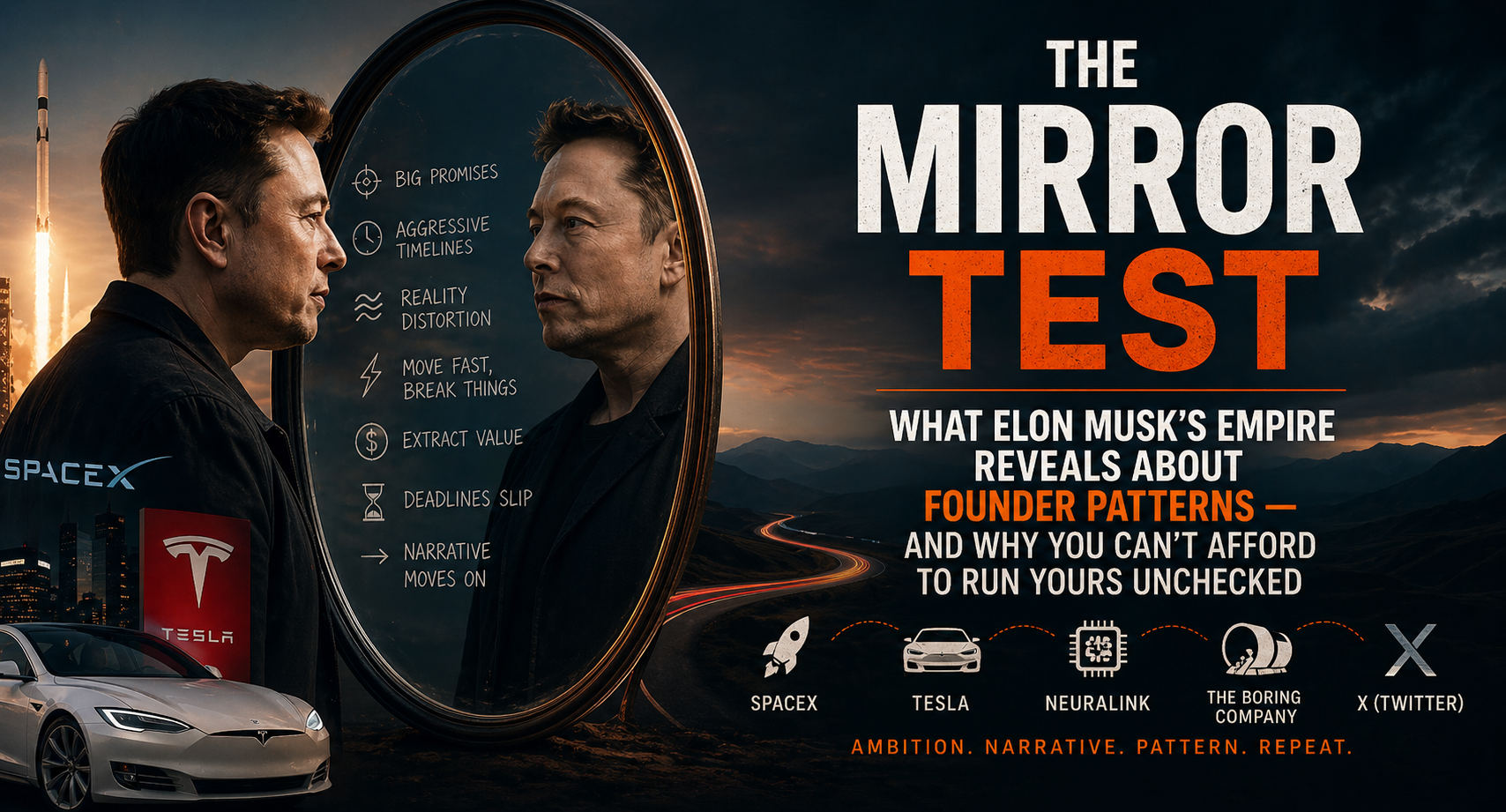
This is not hypocrisy. It's a pattern. And the pattern is the most public, best-documented case study of founder-as-bottleneck in modern business history.
The argument
Every founder has patterns. Reactive promises that overshoot what the team can deliver. Pet projects that survive long after the evidence stops supporting them. Avoided customer conversations. Personal speech that bleeds into the company's brand. Capital reaches that substitute for thinking. Counterweights — co-founders, advisors, board members — gradually removed.
The difference between Elon Musk and most founders is not the patterns. It's that Elon has built a $200+ billion ecosystem with dual-class voting control and trillion-dollar valuations that absorb the cost of running those patterns unchecked. He can take a 58% Tesla brand value collapse and still see his stock rise on robotaxi narrative. He can lose ~$35 billion in Twitter equity value and consolidate it into xAI. He can be found liable for fraud by a federal jury and fund the appeal out of one of his other companies.
You can't.
If you're building a $2M-revenue company, your patterns get priced into your runway in months. Customer churn, hire turnover, advisor relationships, fundraising windows — every one of these will reflect your operating patterns within a single fiscal year. By the time you can see the cost, the runway is gone.
This is not abstract. This is what we see in Clarity on PMF diagnostics every week.
The six patterns, documented in Elon's own words and his companies' outcomes
These are not interpretations. Each is sourced to public records, court filings, on-camera statements, or his authorized biography.
Pattern 1: The timeline is the product
Coast-to-coast self-driving Tesla demo by end of 2017: never happened. Full Self-Driving by 2018: still not delivered as of April 2026. One million robotaxis by 2020: about three dozen operate in Austin in late 2025. Hyperloop at 700 mph: the only operational tunnel runs Tesla cars at 35–40 mph. Mars cargo flight by 2026: Elon himself said "50/50 chance" in May 2025. Starship 2025 launch target: 25. Actual: 5.
Elon told Lex Fridman the operating principle directly: "Stop being patient and start asking yourself, how do I accomplish my 10-year plan in 6 months? You will probably fail but you will be a lot further ahead." His longtime SpaceX engineer Tom Mueller put it differently in Walter Isaacson's biography: "I learned never to tell him no. Just say you're going to try, then later explain why if it doesn't work out."
The structural insight: the announcement of the timeline is the product. It raises capital. It recruits talent. It supports the stock. Whether anything ships is a separate question.
The Clarity on PMF parallel for normal founders: This pattern shows up in our diagnostics as a specific shape — a founder confidently claims customers want X, but their actual sales data shows they're pitching Y, and the gap is masked by aspirational framing. Most founders running this pattern run out of money in 18 months. Elon's been running it for 20+ years and is now the world's wealthiest person.
Pattern 2: The founder is the brand
Tesla brand value: $66.2 billion (peak January 2023) → $43 billion (start of 2025) → $27.61 billion (2026). A 58% collapse over three years. Brand Finance attributed it directly to "CEO Elon Musk's overreach into geopolitics combined with his lack of focus on the auto business."
A Yahoo News/YouGov poll in March 2025 found 67% of Americans would not buy a Tesla, with 37% citing Elon himself as "the whole reason or part of the reason." Tesla fell from 8th to 95th place on the Axios Harris Poll of most visible American brands in 2025. Cybertruck deliveries fell from ~39,000 in 2024 to ~20,000 in 2025 — far below the 250,000-per-year target Elon had floated.
At the New York Times DealBook Summit on November 29, 2023, Elon told advertisers leaving X, on stage, on tape: "If somebody's going to try to blackmail me with advertising? Blackmail me with money? Go fuck yourself. Go. Fuck. Yourself. Is that clear?" Fidelity valued its X stake at 79% below the purchase price by August 2024.
The structural insight: When a founder refuses to separate personal speech from company brand, the company's value moves with the founder's behavior. There's no firewall.
For normal founders: This shows up most often as the founder confusing "personal credibility" with "company credibility." Every time you put your face on the company's marketing, you've fused the two. If you don't have the discipline to manage what comes out of your mouth in public, the company eats the consequences.
Pattern 3: Conflicts of interest as features
SolarCity (2016): Elon's cousins founded it. Elon was chairman with a 22% stake. The company was near insolvent. Elon engineered Tesla's $2.6 billion acquisition. Tesla's board at the time included a SolarCity director, a former SolarCity CFO, and venture capitalists who also sat on SolarCity's board. Elon personally provided bridge financing to keep SolarCity solvent through the acquisition. He promised cash-flow positive within six months of the deal closing; the division wasn't profitable five years later.
xAI/Tesla (August 2024): Wikipedia documents that "Musk was diverting a large number of Nvidia chips that had been ordered by Tesla, Inc." to xAI, a separate private company he controls. xAI then acquired X in March 2025. SpaceX then acquired xAI in February 2026 at a $1.25 trillion combined valuation. Each consolidation step moved value across entities Elon controls while increasing his integrated voting power.
The structural insight: Elon treats his companies as one strategic empire while keeping them legally separate, using the separateness as cover for capital movements that would not survive normal arms-length scrutiny.
For normal founders: This is rarer at small scale, but it shows up as informal versions — hiring family members into key roles, doing deals with friends-of-the-board, paying yourself "consulting fees" through a side entity. Each of these creates exit barriers that compound. If your cap table or your vendor list reads like a family tree, you've got a smaller version of the same structural problem.
Pattern 4: Capital follows attention as leverage
Tesla's board, on the public record (NBC News, December 2025): warned that Elon "could leave the electric car company if he does not get the pay he wants and an increase in his voting power."
November 2025: Tesla shareholders approved a $1 trillion ten-year pay package. January 2026: SpaceX's board approved the Mars package. Compensation expert Eric Hoffmann at Farient Advisors: "SpaceX and Tesla, both effectively controlled by Elon Musk, are now bidding against each other for his attention."
The Boring Company shows the small-scale version: projects announced in Washington DC, Los Angeles, San Jose, Chicago, Dodger Stadium, others — all abandoned when Elon's attention moved.
The structural insight: When a founder's attention is itself a scarce resource that companies bid for, every other capital allocation decision distorts around it. Boards stop saying no. Co-founders learn to chant the algorithm rather than push back.
For normal founders: You don't have the leverage of being a multi-trillion-dollar founder, but you have a smaller version. When you're the only one who can close a deal, design the product, or talk to the key customer, the company is hostage to your attention. The pattern looks like: everything moves through you. Nothing scales without you. The "scarce resource" is you, and your team is bidding for it with their time, their projects, and their morale.
Pattern 5: Eliminate every counterweight, then award yourself the votes
January 30, 2024: Delaware Chancery Court Chancellor Kathaleen McCormick voided Elon's $56 billion 2018 Tesla pay package. Her ruling: Tesla's board "didn't fairly negotiate" because Elon "controlled Tesla." Tesla asked shareholders to revote on the same package. Approved June 2024. Court rejected the ratification in December 2024. Tesla reincorporated to Texas. SpaceX moved to Texas. Tesla shareholders approved a new ~$1 trillion package in November 2025. Delaware Supreme Court reversed itself in December 2025, restoring the original (now $139B) package.
A Harvard Corporate Governance review of the case noted that Elon's behavior met the legal definition of coercion: "threatening reincorporation to a different state, or threatening retaliation (e.g., directing resources away from the company), if the vote is not obtained."
The April 2026 SpaceX package locks this in pre-IPO: 200 million super-voting Class B shares carrying ten votes each. Public investors will buy Class A shares with one vote each. The control ratio is set from the first trading day.
xAI: every co-founder except Elon has departed by April 2026. Half of them coincided with an audit conducted by SpaceX and Tesla.
The structural insight: Whenever an institutional check appears, Elon removes or overrides it, and emerges with more locked-in control than before.
For normal founders: This is the pattern most founders run unconsciously. It looks like: hiring senior people then driving them out, replacing the COO, restructuring the board to add allies, raising rounds at terms that consolidate your voting power. By the time you realize you've removed every voice that might have caught your blind spots, you've already shipped the product that the market won't buy.
Pattern 6: Operational chaos as method
Walter Isaacson, after two years embedded with Elon: "There are about five or six versions of Elon Musk and they change really fast when you're with them." His partner Grimes coined the term "demon mode." Elon himself: "I became a broken record on the algorithm. But I think it's helpful to say it to an annoying degree."
Twitter: rebranded to X, fired a large portion of staff in weeks. xAI Memphis: ran dozens of methane gas turbines for a year before seeking a permit, in a 99% Black neighborhood with documented elevated cancer rates. Cybertruck: eight recalls in the first year on sale. Neuralink: 12 healthy primates euthanized after implant complications, per UC Davis veterinary records; SEC reopened a fraud investigation in December 2024 over Elon's claim that "no monkey has died as a result of a Neuralink implant."
The structural insight: Elon publicly frames chaos as method. His "algorithm" — five operating principles ending with "automate (last)" — embeds the chaos into the system explicitly.
For normal founders: Some chaos is normal in early-stage companies. The pattern that breaks companies is unmanaged chaos — where the founder's emotional state drives the team's operating tempo, and there's no one with the standing to install rhythm. The team burns out, the senior hires leave, and the remaining people learn to "say yes and try" rather than push back. By the time anyone says it out loud, the company has already lost the people it needed most.
The cost, counted honestly
Public, verifiable, realized losses across the Elon empire (excluding paper market-cap swings and aspirational spending that may yet pay off):
This is what unchecked founder patterns cost at full scale, with $200+ billion in ecosystem cash behind the founder.
Why the Mars package is the perfect closing image
The April 28, 2026 SpaceX pay package isn't really about Mars. A self-sustaining colony of 1 million people on Mars is, on every credible engineering timeline, decades away. Elon is 54. He won't be the operational CEO when this milestone is achieved, if it ever is.
What the package actually accomplishes:
It is Pattern 1, Pattern 4, and Pattern 5 written into a single corporate document.
That's the lesson worth absorbing as a founder. The patterns are visible long before they become a crisis. The market sees them. The board sees them. The co-founders see them. The biographer sees them. By the time anyone has the authority to redirect them, the founder has eliminated the structural ability to do so.
You're not going to eliminate your patterns. Every founder has them. The question is whether you can see them in time to compensate.
What Clarity on PMF does, and which version is right for you
Most founders can feel their patterns but can't name them. Half-knowing is enough to feel guilty. Not enough to act.
We built three entry points based on where you actually are:
If you're early-stage and budget-conscious: Start with the free assessment. About 20 minutes, 46 questions. You'll get a PMF score, a risk grade, your top blind spots, and your top 5 fixes — grounded in evidence from your own words. For most founders at $0–$5K MRR, this is enough to move from half-knowing to acting this week.
If you want to go deeper on one specific area: Deep Dives ($197–$297) focus the diagnostic on a single dimension — customer clarity, market position, execution readiness, founder psychology, or idea validation. Best for founders who want to test the methodology on a focused question before committing to the full diagnostic.
If you're funded, post-seed, and your board is asking for PMF evidence: The Full PMF Diagnostic ($1,999) produces a complete diagnostic with a 12-week execution plan where every action traces to a specific finding about how you operate. The bridge between "I suspect I'm part of the problem" and "here's what I do about it Monday."
If you've already completed the Full Diagnostic: Progress Check ($497) measures what's actually changed since your last assessment, separating real progress from confirmation bias.
Elon has 20 years of cash, two trillion-dollar entities, and dual-class voting power to absorb the cost of running his patterns unchecked. You have your runway.
The founders who make it to the other side aren't the ones without patterns. They're the ones who saw their own first.
In the last week of April 2026, two news items appeared on the same founder.
April 23: Elon Musk admitted on Tesla's earnings call that Hardware 3 — installed in millions of cars sold since 2019 with the explicit promise of Full Self-Driving — cannot deliver it. The retrofit program he proposed has no published cost.
April 28: Reuters revealed that SpaceX's board approved a pay package in January tying Elon's compensation to a $7.5 trillion company valuation, a permanent Mars colony of 1 million people, and 100 terawatts of space-based data center compute capacity.
Same week. Same founder. One company admitting it cannot deliver what was promised seven years ago. Another company writing a bigger promise — for goals that on every credible engineering timeline are decades away — into corporate documents.
This is not hypocrisy. It's a pattern. And the pattern is the most public, best-documented case study of founder-as-bottleneck in modern business history.
The argument
Every founder has patterns. Reactive promises that overshoot what the team can deliver. Pet projects that survive long after the evidence stops supporting them. Avoided customer conversations. Personal speech that bleeds into the company's brand. Capital reaches that substitute for thinking. Counterweights — co-founders, advisors, board members — gradually removed.
The difference between Elon Musk and most founders is not the patterns. It's that Elon has built a $200+ billion ecosystem with dual-class voting control and trillion-dollar valuations that absorb the cost of running those patterns unchecked. He can take a 58% Tesla brand value collapse and still see his stock rise on robotaxi narrative. He can lose ~$35 billion in Twitter equity value and consolidate it into xAI. He can be found liable for fraud by a federal jury and fund the appeal out of one of his other companies.
You can't.
If you're building a $2M-revenue company, your patterns get priced into your runway in months. Customer churn, hire turnover, advisor relationships, fundraising windows — every one of these will reflect your operating patterns within a single fiscal year. By the time you can see the cost, the runway is gone.
This is not abstract. This is what we see in Clarity on PMF diagnostics every week.
The six patterns, documented in Elon's own words and his companies' outcomes
These are not interpretations. Each is sourced to public records, court filings, on-camera statements, or his authorized biography.
Pattern 1: The timeline is the product
Coast-to-coast self-driving Tesla demo by end of 2017: never happened. Full Self-Driving by 2018: still not delivered as of April 2026. One million robotaxis by 2020: about three dozen operate in Austin in late 2025. Hyperloop at 700 mph: the only operational tunnel runs Tesla cars at 35–40 mph. Mars cargo flight by 2026: Elon himself said "50/50 chance" in May 2025. Starship 2025 launch target: 25. Actual: 5.
Elon told Lex Fridman the operating principle directly: "Stop being patient and start asking yourself, how do I accomplish my 10-year plan in 6 months? You will probably fail but you will be a lot further ahead." His longtime SpaceX engineer Tom Mueller put it differently in Walter Isaacson's biography: "I learned never to tell him no. Just say you're going to try, then later explain why if it doesn't work out."
The structural insight: the announcement of the timeline is the product. It raises capital. It recruits talent. It supports the stock. Whether anything ships is a separate question.
The Clarity on PMF parallel for normal founders: This pattern shows up in our diagnostics as a specific shape — a founder confidently claims customers want X, but their actual sales data shows they're pitching Y, and the gap is masked by aspirational framing. Most founders running this pattern run out of money in 18 months. Elon's been running it for 20+ years and is now the world's wealthiest person.
Pattern 2: The founder is the brand
Tesla brand value: $66.2 billion (peak January 2023) → $43 billion (start of 2025) → $27.61 billion (2026). A 58% collapse over three years. Brand Finance attributed it directly to "CEO Elon Musk's overreach into geopolitics combined with his lack of focus on the auto business."
A Yahoo News/YouGov poll in March 2025 found 67% of Americans would not buy a Tesla, with 37% citing Elon himself as "the whole reason or part of the reason." Tesla fell from 8th to 95th place on the Axios Harris Poll of most visible American brands in 2025. Cybertruck deliveries fell from ~39,000 in 2024 to ~20,000 in 2025 — far below the 250,000-per-year target Elon had floated.
At the New York Times DealBook Summit on November 29, 2023, Elon told advertisers leaving X, on stage, on tape: "If somebody's going to try to blackmail me with advertising? Blackmail me with money? Go fuck yourself. Go. Fuck. Yourself. Is that clear?" Fidelity valued its X stake at 79% below the purchase price by August 2024.
The structural insight: When a founder refuses to separate personal speech from company brand, the company's value moves with the founder's behavior. There's no firewall.
For normal founders: This shows up most often as the founder confusing "personal credibility" with "company credibility." Every time you put your face on the company's marketing, you've fused the two. If you don't have the discipline to manage what comes out of your mouth in public, the company eats the consequences.
Pattern 3: Conflicts of interest as features
SolarCity (2016): Elon's cousins founded it. Elon was chairman with a 22% stake. The company was near insolvent. Elon engineered Tesla's $2.6 billion acquisition. Tesla's board at the time included a SolarCity director, a former SolarCity CFO, and venture capitalists who also sat on SolarCity's board. Elon personally provided bridge financing to keep SolarCity solvent through the acquisition. He promised cash-flow positive within six months of the deal closing; the division wasn't profitable five years later.
xAI/Tesla (August 2024): Wikipedia documents that "Musk was diverting a large number of Nvidia chips that had been ordered by Tesla, Inc." to xAI, a separate private company he controls. xAI then acquired X in March 2025. SpaceX then acquired xAI in February 2026 at a $1.25 trillion combined valuation. Each consolidation step moved value across entities Elon controls while increasing his integrated voting power.
The structural insight: Elon treats his companies as one strategic empire while keeping them legally separate, using the separateness as cover for capital movements that would not survive normal arms-length scrutiny.
For normal founders: This is rarer at small scale, but it shows up as informal versions — hiring family members into key roles, doing deals with friends-of-the-board, paying yourself "consulting fees" through a side entity. Each of these creates exit barriers that compound. If your cap table or your vendor list reads like a family tree, you've got a smaller version of the same structural problem.
Pattern 4: Capital follows attention as leverage
Tesla's board, on the public record (NBC News, December 2025): warned that Elon "could leave the electric car company if he does not get the pay he wants and an increase in his voting power."
November 2025: Tesla shareholders approved a $1 trillion ten-year pay package. January 2026: SpaceX's board approved the Mars package. Compensation expert Eric Hoffmann at Farient Advisors: "SpaceX and Tesla, both effectively controlled by Elon Musk, are now bidding against each other for his attention."
The Boring Company shows the small-scale version: projects announced in Washington DC, Los Angeles, San Jose, Chicago, Dodger Stadium, others — all abandoned when Elon's attention moved.
The structural insight: When a founder's attention is itself a scarce resource that companies bid for, every other capital allocation decision distorts around it. Boards stop saying no. Co-founders learn to chant the algorithm rather than push back.
For normal founders: You don't have the leverage of being a multi-trillion-dollar founder, but you have a smaller version. When you're the only one who can close a deal, design the product, or talk to the key customer, the company is hostage to your attention. The pattern looks like: everything moves through you. Nothing scales without you. The "scarce resource" is you, and your team is bidding for it with their time, their projects, and their morale.
Pattern 5: Eliminate every counterweight, then award yourself the votes
January 30, 2024: Delaware Chancery Court Chancellor Kathaleen McCormick voided Elon's $56 billion 2018 Tesla pay package. Her ruling: Tesla's board "didn't fairly negotiate" because Elon "controlled Tesla." Tesla asked shareholders to revote on the same package. Approved June 2024. Court rejected the ratification in December 2024. Tesla reincorporated to Texas. SpaceX moved to Texas. Tesla shareholders approved a new ~$1 trillion package in November 2025. Delaware Supreme Court reversed itself in December 2025, restoring the original (now $139B) package.
A Harvard Corporate Governance review of the case noted that Elon's behavior met the legal definition of coercion: "threatening reincorporation to a different state, or threatening retaliation (e.g., directing resources away from the company), if the vote is not obtained."
The April 2026 SpaceX package locks this in pre-IPO: 200 million super-voting Class B shares carrying ten votes each. Public investors will buy Class A shares with one vote each. The control ratio is set from the first trading day.
xAI: every co-founder except Elon has departed by April 2026. Half of them coincided with an audit conducted by SpaceX and Tesla.
The structural insight: Whenever an institutional check appears, Elon removes or overrides it, and emerges with more locked-in control than before.
For normal founders: This is the pattern most founders run unconsciously. It looks like: hiring senior people then driving them out, replacing the COO, restructuring the board to add allies, raising rounds at terms that consolidate your voting power. By the time you realize you've removed every voice that might have caught your blind spots, you've already shipped the product that the market won't buy.
Pattern 6: Operational chaos as method
Walter Isaacson, after two years embedded with Elon: "There are about five or six versions of Elon Musk and they change really fast when you're with them." His partner Grimes coined the term "demon mode." Elon himself: "I became a broken record on the algorithm. But I think it's helpful to say it to an annoying degree."
Twitter: rebranded to X, fired a large portion of staff in weeks. xAI Memphis: ran dozens of methane gas turbines for a year before seeking a permit, in a 99% Black neighborhood with documented elevated cancer rates. Cybertruck: eight recalls in the first year on sale. Neuralink: 12 healthy primates euthanized after implant complications, per UC Davis veterinary records; SEC reopened a fraud investigation in December 2024 over Elon's claim that "no monkey has died as a result of a Neuralink implant."
The structural insight: Elon publicly frames chaos as method. His "algorithm" — five operating principles ending with "automate (last)" — embeds the chaos into the system explicitly.
For normal founders: Some chaos is normal in early-stage companies. The pattern that breaks companies is unmanaged chaos — where the founder's emotional state drives the team's operating tempo, and there's no one with the standing to install rhythm. The team burns out, the senior hires leave, and the remaining people learn to "say yes and try" rather than push back. By the time anyone says it out loud, the company has already lost the people it needed most.
The cost, counted honestly
Public, verifiable, realized losses across the Elon empire (excluding paper market-cap swings and aspirational spending that may yet pay off):
- ~$35 billion equity value destroyed in the Twitter acquisition
- $2.6 billion SolarCity acquisition that never delivered the promised profitability
- $2.1–2.6 billion in damages from the March 2026 jury verdict for misleading Twitter shareholders
- $39 billion → $27 billion Tesla brand value collapse in 2025 alone (a one-year $12 billion erosion)
- ~$380 billion Tesla market cap loss in the first half of 2025
- Hardware 3 retrofit liability across millions of vehicles, cost undisclosed
- Eight Cybertruck recalls in the first year on sale; deliveries 50% below the previous year
- Every standalone Boring Company project except the Las Vegas Loop
- Every xAI co-founder except Elon, departed during the SpaceX consolidation
This is what unchecked founder patterns cost at full scale, with $200+ billion in ecosystem cash behind the founder.
Why the Mars package is the perfect closing image
The April 28, 2026 SpaceX pay package isn't really about Mars. A self-sustaining colony of 1 million people on Mars is, on every credible engineering timeline, decades away. Elon is 54. He won't be the operational CEO when this milestone is achieved, if it ever is.
What the package actually accomplishes:
- Justifies a $7.5 trillion valuation in IPO marketing
- Locks in voting control through 200 million super-voting shares before the IPO opens
- Sets an unfalsifiable performance metric — Elon doesn't have to deliver Mars to keep the package; he just has to remain employed
- Forces Tesla to compete for his attention with an even bigger package
- Reframes accountability — when Tesla's robotaxi underdelivers, the cover story becomes "his attention is on Mars"
It is Pattern 1, Pattern 4, and Pattern 5 written into a single corporate document.
That's the lesson worth absorbing as a founder. The patterns are visible long before they become a crisis. The market sees them. The board sees them. The co-founders see them. The biographer sees them. By the time anyone has the authority to redirect them, the founder has eliminated the structural ability to do so.
You're not going to eliminate your patterns. Every founder has them. The question is whether you can see them in time to compensate.
What Clarity on PMF does, and which version is right for you
Most founders can feel their patterns but can't name them. Half-knowing is enough to feel guilty. Not enough to act.
We built three entry points based on where you actually are:
If you're early-stage and budget-conscious: Start with the free assessment. About 20 minutes, 46 questions. You'll get a PMF score, a risk grade, your top blind spots, and your top 5 fixes — grounded in evidence from your own words. For most founders at $0–$5K MRR, this is enough to move from half-knowing to acting this week.
If you want to go deeper on one specific area: Deep Dives ($197–$297) focus the diagnostic on a single dimension — customer clarity, market position, execution readiness, founder psychology, or idea validation. Best for founders who want to test the methodology on a focused question before committing to the full diagnostic.
If you're funded, post-seed, and your board is asking for PMF evidence: The Full PMF Diagnostic ($1,999) produces a complete diagnostic with a 12-week execution plan where every action traces to a specific finding about how you operate. The bridge between "I suspect I'm part of the problem" and "here's what I do about it Monday."
If you've already completed the Full Diagnostic: Progress Check ($497) measures what's actually changed since your last assessment, separating real progress from confirmation bias.
Elon has 20 years of cash, two trillion-dollar entities, and dual-class voting power to absorb the cost of running his patterns unchecked. You have your runway.
The founders who make it to the other side aren't the ones without patterns. They're the ones who saw their own first.


